Chemical and sludge tracking proposal.
Following is a proposal for chemicals and sludge disposal tracking web application development by Magnus Code Sdn Bhd.
Background
MRCSB have pain points on 2 of the following items:
-
Sludge not removed in a timely manner from the plant.
-
Chemicals expiring at the storage areas inside the plant.
Info
These happen without people realizing it and the status of all chemicals on hand at a given point is unknown.
Proposed Solution
A web application that allows tracking1 and visibility of all chemicals coming into the plant and also for sludge going out of the plant.
Notification/alerts will be sent for soon to be expiring chemicals (e.g., 30 days before expiring) via the application to give visibility on the chemical status and to allow for better planning for consumption priority.
Notification and alerts
Notifications will directly solve the pain point of people not realizing the current status of the chemical/sludge.
User journey
Following is a detail explanation of the process flow of the proposed solution. 2 sections are included, one for chemicals and one for sludge disposal.
Additionally, there will be a section on tracking and visibility of the chemicals and sludge which includes viewing the status of the chemicals and sludge and the alert/notification system.
Recieving chemicals
Info
The above process does not change with the introduction of the proposed solution.
Chemical registration process
MRCSB will have to introduce the following on top of their current process. Continuing from above, the chemical registration process will be as follows:
Sludge disposal
Sludge disposal registration process
MRCSB will have to introduce the following on top of their current process. Continuing from above, the sludge disposal registration process will be as follows:
Info
Second verification is recommended after loading the sludge into the disposal truck.
Process details
Label printing
Label printing involves a few steps:
- A unique QR code is generated for each chemical drum and sludge container.
- Label printer prints the QR code on the label. This label is tamper proof and cannot be removed without damaging the label for security purposes.
- The label is then pasted on the chemical drums or sludge containers.
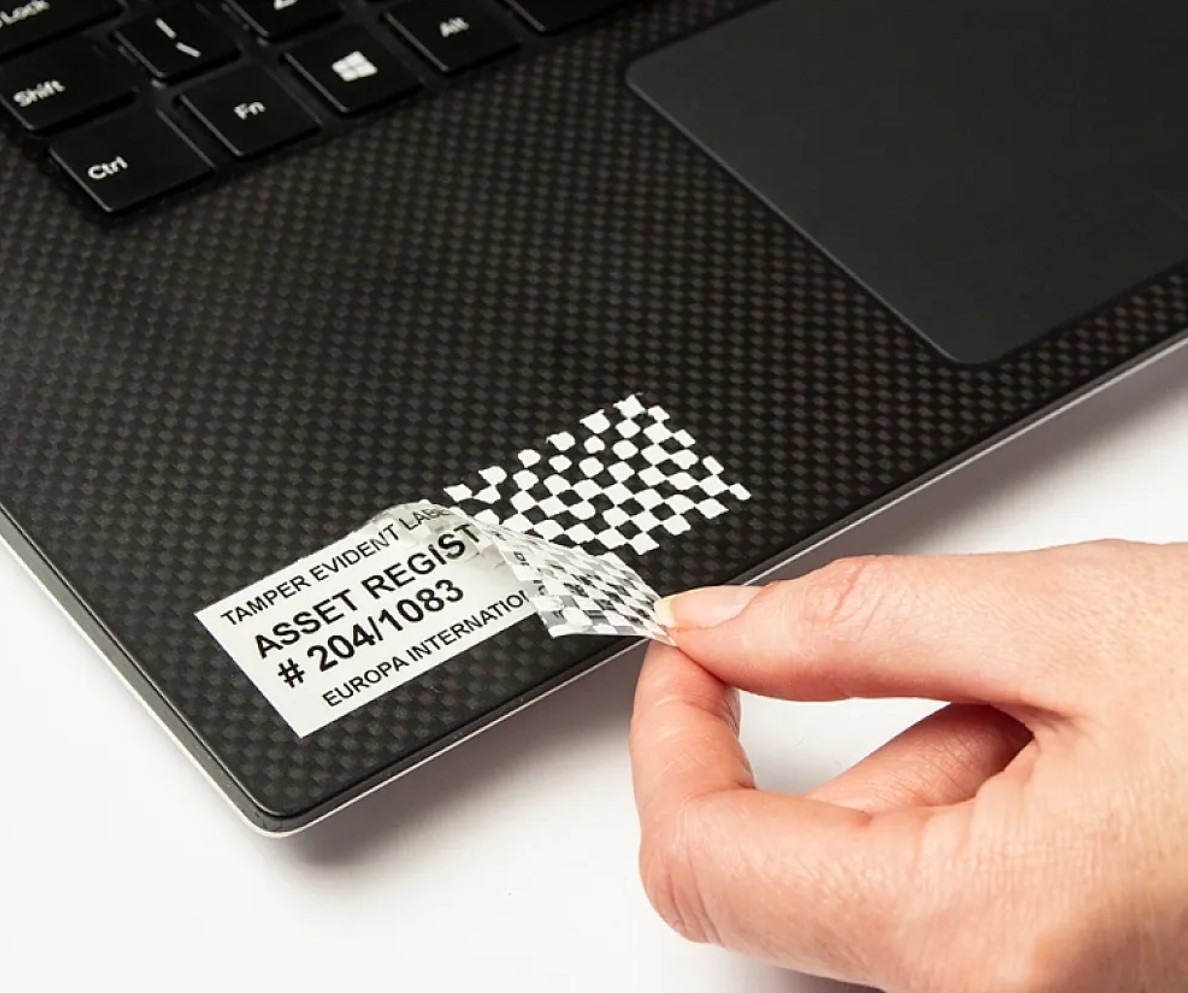
Universally unique identifier
The generated QR code is a universally unique identifier (UUID) which is a 128-bit number used to identify information in computer systems. This allows for better user experience as the user does not have to care about sequence numbers, unused codes can be easily replaced and the system can be scaled to a large number of chemicals/drums.
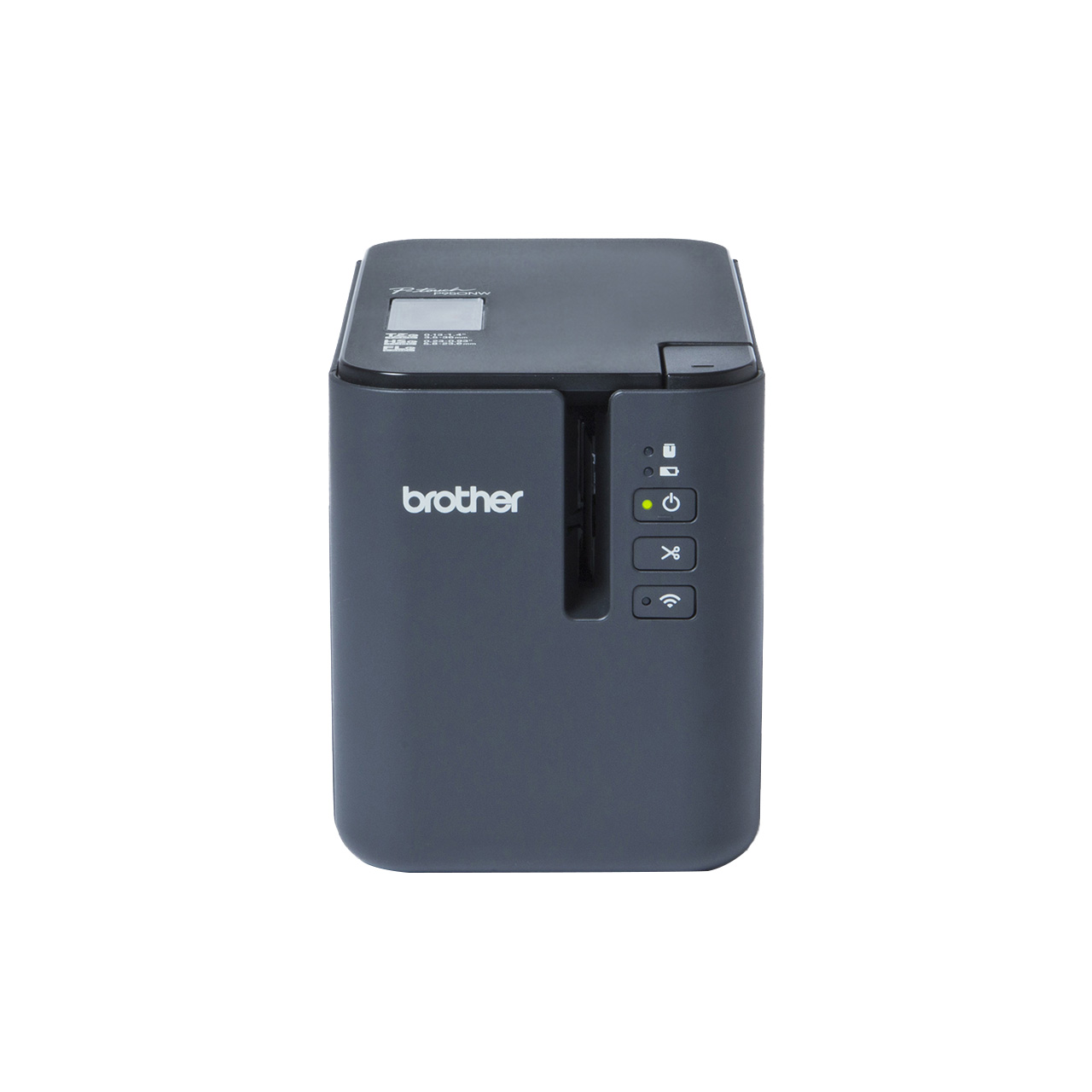
Specification for the industrial label printer and the label cartridges are as follows:
- Label printer: Brother PT-P950NW Label Printer
- Label cartridge: Tamper proof security label - 24mm : Tze-SE5
Scan chemical/sludge drum QR code
The chmical drum or sludge container QR code is scanned using an approved device (e.g., a tablet authorized/safe to be used in plant) and the information is then entered into the web application.
Once all information is entered and verified, the system is ready for tracking purposes.
Tracking and visibility
At any point in time, the user can view the status of the chemicals and sludge. The status includes:
- Chemical expiring in 30 days
- Chemical available
- Sludge disposal scheduled
- Sludge disposal overdue for 30 days
- Sludge disposed
Info
Users will also be notified via the web application when a chemical is expiring in 30 days or when a sludge disposal is overdue for 30 days. This can be customized according to MRCSB's preference.
Other than viewing the status of the chemicals and sludge, the user can also view the current location of the chemicals and sludge and also the quantity of certain chemicals on hand. Similar details can also be viewed for the sludge containers.
Location and status change
User is also allowed to change the location of the chemicals and sludge. This is useful when the chemicals and sludge are moved from one location to another. Similarly, the user can also change the status of the chemicals and sludge (e.g., from available to consumed).
Chemical consumption and sludge disposal
Once the chemical is consumed or the sludge is disposed, this information is recorded for tracking purposes and is available for viewing at a later point in time for audit purposes. Retention period is not defined at this point but 5 years is recommended.
Notification and alerts
Notification and alerts are sent to the user via the web application when a chemical is expiring in 30 days or when a sludge disposal is overdue for 30 days. This can be customized according to MRCSB's preference.
Application features
The application will have the following features:
- QR code generation
- QR code scanning
- Chemical registration
- Sludge registration
- Chemical tracking
- Sludge tracking
- Chemical location change
- Sludge location change
- Chemical status change
- Sludge status change
- Chemical consumption
- Sludge disposal
- Notification and alerts
- Supplier database
- Person in charge database
- Sludge disposal contractor database
Actions needed from MRCSB
MRCSB will have options to do the following:
-
Accept training on the proposed solution from Magnus Code and carry out the process changes after the training/after the solution is implemented by Magnus Code.
-
Appoint Magnus Code to carry out the process changes fully for a year on top of the training above to get familiar with the proposed solution.
Execution plan
The execution plan is as follows:
- MRCSB to accept the proposal and Magnus Code to start the project.
- Magnus Code to carry out the following:
- Finalize the requirements with MRCSB.
- Design the solution and present the final design file for approval.
- Once design is approved, Magnus Code to start the development.
- Magnus Code to carry out the testing and present the final solution for approval.
- Magnus Code to carry out the training and handover to MRCSB.
Agile development
During the development phase, Magnus Code will be in constant communication with MRCSB to ensure that the requirements are met. Agile development of 2 week sprints will be used to ensure that the solution is meeting the requirements.
Project timeline
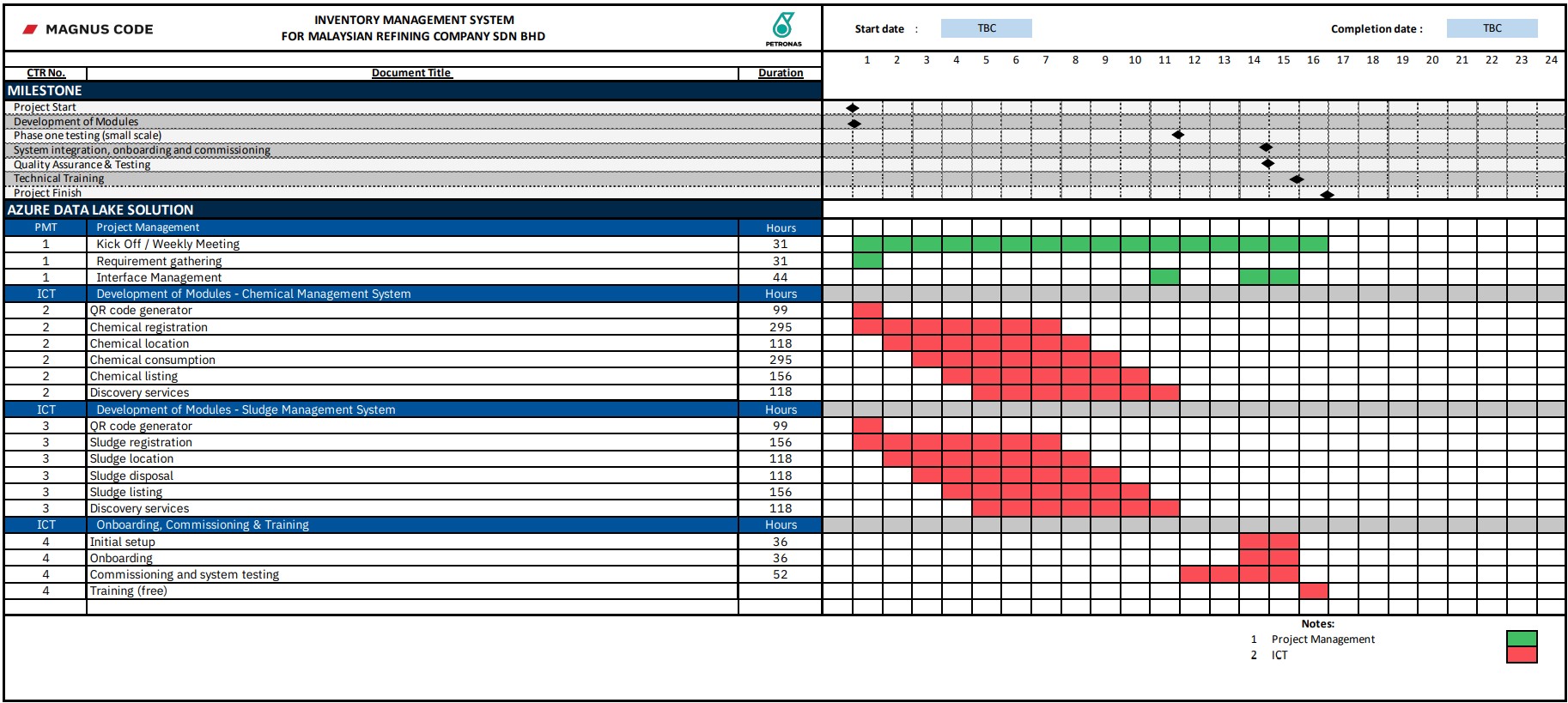
The project timeline is as follows:
- Project start
- Requirements gathering and design phase - 1 week
- Interface management - 3 weeks
- Development phase - 11 weeks
- Testing phase - 4 weeks
- Deployment to production - 2 weeks
Where possible, Magnus Code will carry out the project in parallel to minimize the overall project duration.
Total time for the project is 16 weeks (Refer to the detail timeline below).
Project cost
The project cost is as follows:
- One time development fee
| Description | Price (MYR) |
|---|---|
| Project Management/ Requirement gathering | 23,640 |
| Chemical Management System | 129,720 |
| Sludge Management System | 91,800 |
| Onboarding, deployment and training | 14,880 |
| Total | 260,040 |
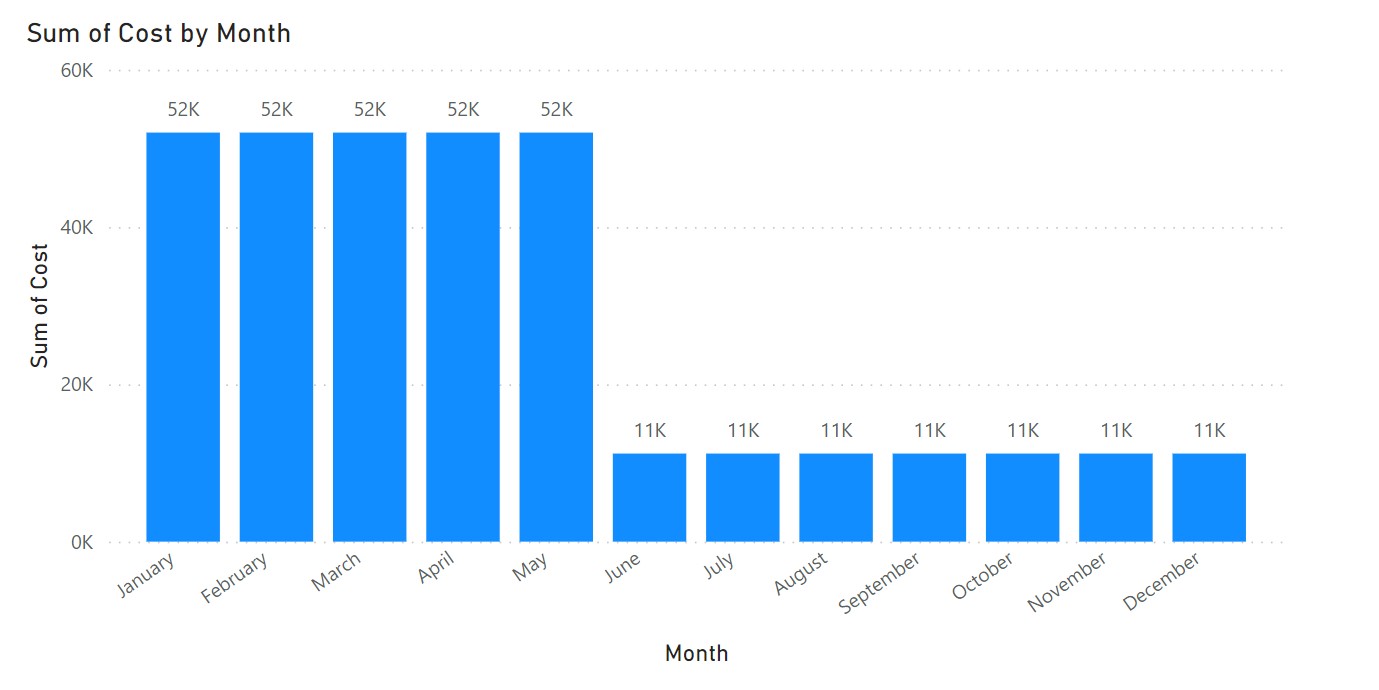
- Monthly subscription fee
| Description | Price (MYR) |
|---|---|
| Software license | 8,000 |
| Authorization server | 1,500 |
| Elasticsearch | 1,500 |
| Application server | 200 |
| Api server | Free |
| Total | 11,200 |
- Total cost (First 12 Months, project completion within 5 months)
| Description | Price (MYR) |
|---|---|
| One time fee | 260,040 |
| Monthly fee | 78,400 |
| Total | 338,440 |
- Cost for second year onwards (yearly)
| Description | Price (MYR) |
|---|---|
| Monthly fee | 11,200 |
| Total | 134,400 |
Full detail of the cost is available in the Development and Maintenance agreement, document version number 1001_10-11-2022.
Note
Hardware cost is not included in the above cost. Estimate for the hardwares are available in the Maintenance and Support agreement, and will be finalized together with MRCSB.
Change request
MRCSB can request for changes to the system at any point in time through the change request process. The change request process is as follows:
- MRCSB to submit the change request to Magnus Code.
- Magnus Code to review the change request and provide a quote for the change request.
- MRCSB to approve the quote and Magnus Code to carry out the change request.
Payment terms
Payment terms are as follows:
- 20% of the total cost is to be paid upfront.
- 60% of the payment is to be paid as the project progresses by milestone definition (2 week sprint - Agile).
- 20% of the payment is to be paid after the project is completed and deployed to production.
Monthly subscription fee is to be paid either on quarterly or yearly basis.
-
Tracking here is defined as, at any given time, an authorized individual could track the quantity of chemicals/sludge on hand, the location, and also the status (e.g., Expiring in 90 days) so that the visibility of all chemicals/sludge is clear. ↩